
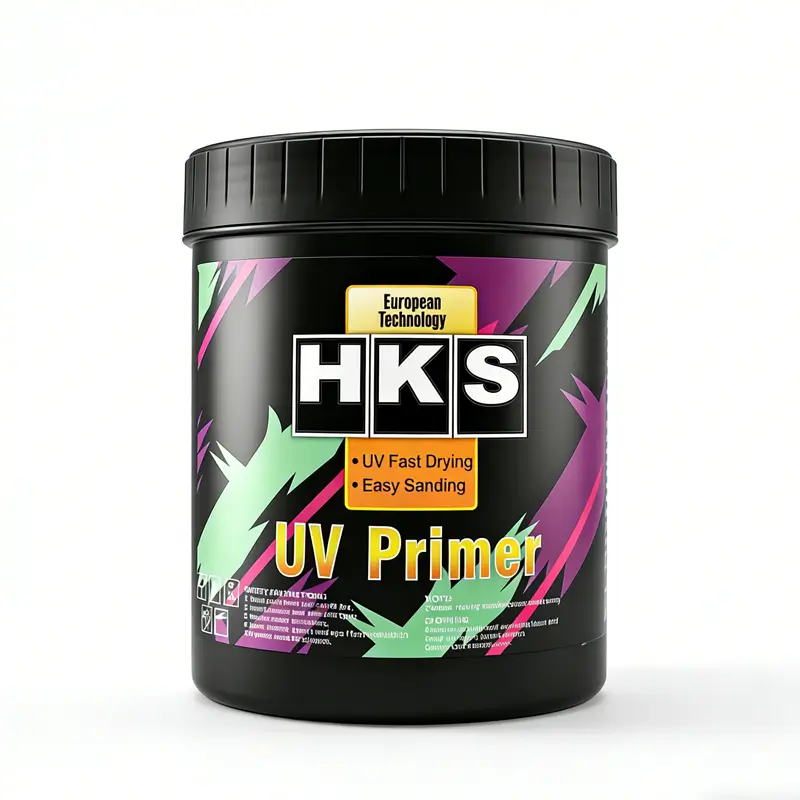
UV Curing Primer for Automotive Refinishing
One of the chief bugbears for automotive refinishers and car body repair shops is the length of time that primers, paints and lacquers need to dry before the next coat can be applied. These delays cause bottlenecks in spray booths and hamper productivity, but recoating too early can trigger more serious problems.
One solution to this problem is to use UV curing primer. Let’s take a closer look.
Why Non-UV Primers Need So Much Drying Time
Like any surface coating that is applied wet, automotive primers are a combination of liquids and solids. The liquid elements are there to hold the solids in a suspension until the primer has been applied, and then the drying or curing process can begin.
This process requires the evaporation of the liquid element to turn the primer into a layer that is comprised solely of solids. With a conventional 2K primer, air drying can take 60 minutes and even with a heated booth may require a 30-minute bake cycle.
If primer is sanded before it is fully dry, it won’t sand cleanly and is more likely to clog fine sandpaper.
If evaporation isn’t complete before the next coat is applied, the liquids may become trapped underneath the new coating. The topcoat may acquire a dull or hazy finish, or even form blisters, and when this happens the paint has to be stripped back, the primer reapplied (if it has been damaged) and left to fully dry.
How UV Primer Works So Much Faster
UV primers are formulated to remain in a fully liquid state unless and until they are exposed to ultraviolet radiation, but when this happens it happens very quickly. The time required for the liquids to evaporate will depend on the strength of the UV light source, but curing will be complete after about 120 seconds, after which it is ready for sanding or painting.
What Are The Other Benefits Of Using UV Primer?
While UV primers require a UV light source to cure them, this is a worthwhile investment that will soon be repaid in improved productivity and results.
Added to that, UV primers bring many more benefits to the Paintshop.
UV Curing Primer Is Ready To Use
As UV curing primer is a single component (1K) primer it doesn’t need to be mixed with a hardener before use and it rarely requires reducing. This means that priming can begin with minimal preparation beyond the usual surface preparation and masking. Excellent adhesion directly onto almost any surface also means that etch primer is for the most part not required before applying UV primer.
UV Curing Primer Is Less Prone To Shrinkage
This is another advantage of the higher solids content of UV curing primer. As solids constitute a greater percentage of the ‘wet’ primer, there is less evaporation and therefore less shrinkage. The rapid, 100% cure also reduces this risk and means that if any shrinkage does occur this will become obvious within the 60-second cure time and can be rectified immediately.
UV Curing Primer Is More Energy-Efficient
At a time when we are all focusing on reducing our energy bills, UV curing primer offers a more energy-efficient alternative to running a heated booth, where a 30-minute bake cycle at 60 degrees C can cost up to £50. UV light sources do use some electricity, but the power is directed at and restricted to the primed surface, so for a repair that’s approximately the size of a sheet of A4 paper the energy cost is approximately £0.05
HK705 UV Primer – The Ultimate In Fast, Professional Priming
This UV-curing technology is now even more convenient with the launch of HK705 UV Primer. We have introduced this product into the range to assist faster, more cost-efficient automotive refinishing.
High build characteristics and excellent adhesion to many substrates including bare steel, aluminium, painted surfaces and most plastics are other features of this technologically-advanced primer.
Source of this article:https://www.supersybon.com/
Get to know us through more channels: