

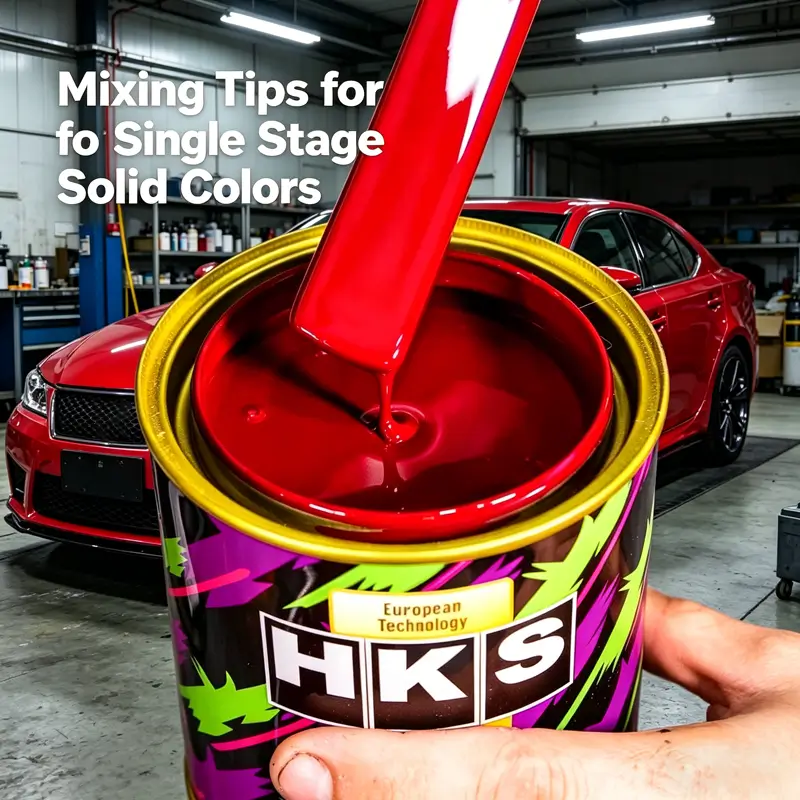
Mixing Tips for Single Stage Solid Colors: How to Achieve Accurate, Consistent Results
Single stage solid colors remain one of the most practical and widely used finishes in automotive refinish work. Also known as pure colors or solid colors, they are different from metallic paints because they do not rely on metallic flakes to create their appearance. That means the color result is generally easier to control, but accurate mixing is still essential for achieving a clean, professional finish.
For import agents, wholesalers, distributors, fleet owners, and repair shops, mastering the right mixing tips for single stage solid colors can save time, reduce waste, and improve customer satisfaction. Even though solid colors are less sensitive to application conditions than metallic paints, the wrong pigment choice, weak tint selection, or poor shade judgment can still lead to visible color differences.
Why Single Stage Solid Colors Are Easier to Mix
Compared with metallic finishes, single stage solid colors are less affected by spraying technique, lighting, and application environment. Because the color is more uniform, it is often easier to match and repair. However, “easier” does not mean “automatic.” The final result still depends on the strength of the colorants, the purity of the pigments, and the way the formula is adjusted.
A correct mixing process should always consider the wet state of the paint, the dry state after curing, the hiding power of each pigment, and the way the color appears under different lights.
Key Mixing Tips for Single Stage Solid Colors
1. Understand the effect of the colorants
White colorants and some yellow colorants are among the heaviest pigments. Because of their high pigment density, they can easily create a noticeable difference between wet paint and the sprayed test panel. In other words, what looks correct in the mixing cup may appear darker or more saturated after application.
When the wet paint contains a certain amount of white or yellow tint, the mix should often be adjusted to look slightly lighter than the standard panel during visual comparison. This helps compensate for the color shift that happens during spraying and drying.
2. Use high-purity colorants whenever possible
Solid automotive colors often lean toward bright and vivid tones, especially red, blue, and yellow. For these colors, it is better to use high-purity colorants and minimize the use of black tint.
Black can reduce brightness and dull the finish if used too much. In many cases, only a very small amount is needed to fine-tune the depth or tone. If the goal is a strong, clean, and attractive color, purity should remain a priority during formulation.
3. Avoid low-strength colorants as the main base
Low-strength colorants should not be chosen as the main color base unless there is no better option. If they must be used, they should be paired with high-hiding-power colorants to maintain coverage and stability.
This is especially important for vivid reds, where weak pigments may cause poor hiding, unstable shade reproduction, or excessive formula correction. A strong base formula gives better consistency for repeat jobs and helps body shops improve productivity.
4. Mixing white requires extra precision
White paint may become slightly yellow after long-term use or exposure. When mixing white, it is best to use low-strength, more transparent colorants so the adjustment range remains controlled.
White is one of the easiest colors for the human eye to judge, which means even a small variation can be obvious. Using low-strength tinting materials allows technicians to make smaller corrections and avoid overshooting the target shade.
5. Mixing black requires attention to gloss
The gloss level of black has a major impact on how the color is judged. Freshly sprayed black paint often has a very high gloss, which may make it look darker than the original surface. Before comparing colors, it can help to polish or wax the surface slightly so the gloss difference is reduced.
In some cases, adding a small amount of white colorant to the original black formula can make the tone slightly softer and less harsh, which improves matching accuracy. Black should always be evaluated carefully under the same viewing conditions as the standard panel.
6. Watch out for metamerism
Metamerism happens when the same color looks different under different light sources, such as sunlight, indoor light, or spray booth lighting. A color may look correct outdoors but appear different indoors because each pigment reflects and absorbs light differently.
The real job of color matching is not only to match a sample under one light, but to create a formula that performs well under the relevant light conditions. If metamerism is severe, the problem often comes from using the wrong colorants. In that case, simply increasing or reducing the amount of the current colorants may not solve the issue. The formula itself may need to be changed.
Practical Mixing Workflow for Repair Shops
| Step | Best Practice | Why It Matters |
|---|---|---|
| Identify the target color | Confirm the standard panel or vehicle reference | Prevents formula errors and ensures accurate starting point |
| Check the pigment type | Determine if the color is white, black, red, yellow, or other solid tones | Different pigments require different adjustment strategies |
| Mix gradually | Add colorants in small increments | Reduces risk of overcorrection and material waste |
| Compare wet and dry results | Evaluate color before and after drying | Accounts for color shift after curing |
| Test under multiple lights | Check under sunlight, indoor light, and spray booth lighting | Helps detect metamerism and avoid mismatch |
| Adjust the formula carefully | Change colorant type if necessary, not only quantity | Improves long-term color accuracy and repeatability |
Why SYBON Is a Strong Choice for Distributors and Refinish Professionals
SYBON is a leading Chinese automotive paint manufacturer that combines reasonable pricing with dependable product quality. While our brand may not be as widely known as some global names, our quality is comparable to major brands, and our cost performance is a major advantage.
For distributors and wholesalers who want competitive products without high purchasing pressure, SYBON offers a practical way to enter local markets and grow profitably. For repair centers, fleet users, and paint stores, SYBON provides a one-stop purchasing solution across automotive refinish products, helping simplify sourcing and improve business efficiency.
SYBON is actively looking for global agents and distributors. We welcome paint shops, body shop owners, and automotive refinish businesses that want to test our products and explore long-term cooperation. If you are looking for a price-competitive manufacturer with stable quality, SYBON is ready to support your business growth.
FAQ: Mixing Tips for Single Stage Solid Colors
1.What makes single stage solid colors easier to mix than metallic colors?
Single stage solid colors do not contain metallic flakes, so they are generally less affected by spraying angle, overlap, and reflection changes.
2.Why do white and yellow colorants need special attention?
They are heavy pigments and can create visible shade differences between wet and dry paint, especially when compared to the standard panel.
3.Can I use black colorant to improve vivid colors?
Yes, but only in very small amounts. Too much black can reduce brightness and make the color look dull.
4.Why does a color look different under different lights?
This is metamerism. Different light sources reveal different reflectance behavior in pigments, so a color may shift from sunlight to indoor lighting.
What should I do if the formula still does not match?
If the mismatch is caused by metamerism or the wrong pigment selection, the colorants themselves may need to be changed rather than simply adjusted by quantity.
Conclusion
Successful mixing tips for single stage solid colors depend on understanding pigment behavior, controlling gloss, managing wet-to-dry differences, and checking color under multiple light sources. Solid colors may be easier than metallic finishes, but professional results still require experience, patience, and the right materials.
For import agents, distributors, fleet owners, and repair professionals, SYBON offers a smart combination of quality, value, and one-stop automotive refinish supply. If your goal is to improve performance, win more local business, and source reliable products at a competitive price, SYBON is a partner worth considering.
Source of this article:https://www.supersybon.com/
Get to know us through more channels: