

Automotive Paint Application Problems: Common Phenomena and SYBON’s Practical Solutions
When applying automotive pearl paint, many painters and refinishing businesses run into application problems that directly affect appearance, consistency, and final quality. For import agents, wholesalers, distributors, fleet owners, and body repair shops, these issues do not only cause rework and wasted material, but also damage customer trust and profit margins.
Automotive paint application problems are especially common in pearl coatings because pearl pigments are highly sensitive to spraying method, mixing quality, material compatibility, film thickness, and drying conditions. A pearl finish is supposed to deliver depth, sparkle, and visual movement. However, when the coating process is not properly controlled, the result can be patchiness, poor coverage, weak pearl effect, color variation, or even mechanical performance loss.
Below are the most common automotive pearl paint application problems, their causes, and SYBON’s recommended solutions.
1. Mottling and Poor Pearl Pigment Orientation
One of the most common problems is mottling, also known as uneven clouding or “flowering” in the finish. This happens when pearl pigments do not lay down in the same direction, causing the surface to look inconsistent under different lighting angles.
Main causes:
- The paint is sprayed too thickly or the spray gun is held too close to the surface.
- Silicone contamination, oil contamination, or the influence of leveling agents, defoamers, and plasticizers in the formulation or primer.
- Too much high-boiling solvent in the thinner.
SYBON’s solution:
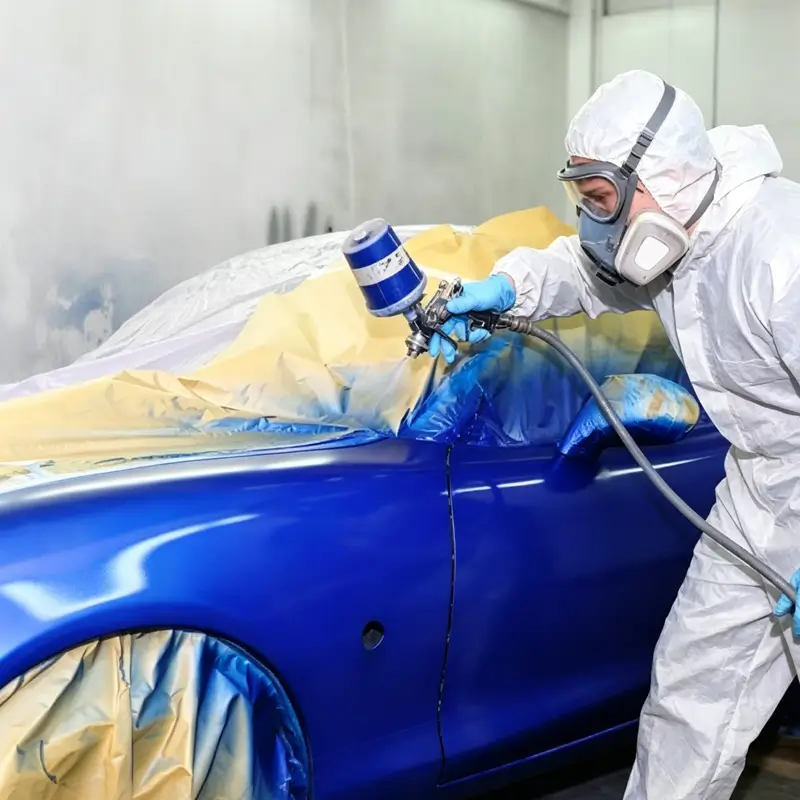
- Improve spraying technique and control the spray distance.
- Clean tools and substrates thoroughly and improve additive selection.
- Adjust the thinner composition.
- Introduce an appropriate orientation additive when needed.
For pearl paint, correct application matters as much as the formula itself. Even a high-quality coating can fail if the spraying process is unstable.
2. Poor Hiding Power
Pearl coatings sometimes fail to cover the base layer properly, especially when the pigment content is too low or the paint is not mixed well before application. This is a major concern for shops that need fast turnaround and consistent repair results.
Main causes:
- The pearl pigment dosage is too low.
- The coating was not stirred properly before spraying.
- A very light pearl color is applied over a dark substrate.
SYBON’s solution:
- Increase the pigment to the correct dosage.
- Mix carefully before use, especially when using fine pearl pigments.
- Apply a light-colored primer first when needed.
- Use fine pearl pigments or aluminum pigment to improve hiding and appearance.
A stable base coat system is essential for achieving the correct appearance and reducing unnecessary rework.
3. Fast Sedimentation
If the pearl paint settles too quickly during storage or use, the product becomes difficult to manage and can produce inconsistent spraying results.
Main causes:
- The automotive pearl paint is too thin.
- The anti-settling agent is not suitable.
SYBON’s solution:
- Increase the solid content of the paint during storage.
- Use a proper anti-settling agent that matches the system.
Fast sedimentation is often a sign that the formula is not balanced. A good pearl coating should remain workable and stable during storage and application.
4. Severe Flocculation and Clumping
Severe flocculation means the pearl paint forms lumps, clumps, or unstable agglomerates. This problem can make the coating unusable and cause serious defects in the finished surface.
Main causes:
- Poor storage stability.
- Mismatched thinner or excessive dilution, which can cause resin precipitation and interaction problems with other pigments.
- Incorrect anti-settling agent selection.
SYBON’s solution:
- Check the paint base and pigment mixture except for the pearl pigment itself, and carry out compatibility tests.
- Select a suitable wetting agent.
- Improve storage stability through better formula design.
This is one of the clearest examples of why system compatibility is critical in automotive refinish coatings. A paint system must be stable not only in the can, but also in real-world workshop conditions.
5. Poor Pearl Effect
Sometimes the paint may look technically applied, but the final pearl effect is weak, flat, or lifeless. For body shops and distributors, this is a serious quality issue because the finish does not meet customer expectations.
Main causes:
- Poor stability or weak compatibility among paint components.
- Insufficient fineness of pigment dispersion.
- Too much inorganic pigment or filler.
- Poor pearl pigment orientation.
- Over-dispersion under high shear force.
SYBON’s solution:
- Check the coating system without the pearl pigment; after curing, it should be nearly transparent.
- Use the correct formulation method.
- Improve orientation during application.
- Disperse at low speed for a slightly longer time.
The pearl effect depends on a balanced formulation and careful processing. Overworking the material can damage the visual performance of the pearl particles.
6. Graininess and Particle Defects
Grainy surfaces or particle defects can seriously reduce the smoothness and premium appearance of the finish.
Main causes:
- Other pigments flocculate or become coarse again.
- The base material is unstable and releases impurities.
- The pearl pigment is not well dispersed.
SYBON’s solution:
- Check the paint before adding pearl pigment.
- Use the correct dispersion method.
- Make sure the base material is stable and clean.
For refinishing work, surface smoothness is a direct indicator of product and process quality.
7. Color Shift
Color shift means the coating changes tone unexpectedly. This can happen after application or after drying, and it creates batch inconsistency that distributors and fleet operators do not want.
Main causes:
- Base material discoloration or coloring impurities.
- Fading of other pigments.
SYBON’s solution:
- Inspect the coating without the pearl pigment.
- Identify whether the base system or other pigments are causing the shift.
Color stability is especially important for repeat orders, large repair fleets, and long-term distributor customers.
8. Reduced Mechanical Performance After Adding Pearl Pigment
If the finished coating becomes weaker after adding pearl pigment, the problem usually comes from formula imbalance.
Main causes:
- Excessive pearl pigment dosage.
SYBON’s solution:
- Reformulate the system correctly and keep the pigment dosage within the proper range.
A beautiful finish is not enough. The coating must also retain durability, adhesion, and film strength.
9. Loss of Gloss
Loss of gloss makes the painted surface look dull and cheap. This is especially unacceptable for premium refinish work.
Main causes:
- The base material does not have enough weather resistance or corrosion resistance.
- The pearl pigment is not suitable.
- The paint is used in harsh environmental conditions.
SYBON’s solution:
- Improve the base material.
- Select weather-resistant pearl pigments.
Gloss retention is a long-term performance issue that affects both appearance and customer satisfaction.
10. Color Difference Between Product Batches
Batch-to-batch color differences create major problems for distributors, wholesalers, and repair centers that need stable repeatability.
Main causes:
- Accumulated deviations in the base material, color paste, and mixed paint stages.
- Pearl pigments with poor stability.
SYBON’s solution:
- Strictly control raw material quality.
- Maintain a strict quality control system.
For professional buyers, consistency is not optional. It is the foundation of brand trust and repeat business.
Why SYBON Is the Right Choice
SYBON understands that import agents, wholesalers, distributors, fleet owners, and repair shops need more than just paint. They need stable quality, reasonable pricing, and one-stop procurement support. As a leading Chinese automotive paint manufacturer, SYBON has become a trusted partner for businesses that want reliable refinish products without paying the high cost of big international brands.
Compared with many well-known brands, SYBON may not have the same global name recognition, but the quality is highly comparable, while the price is far more competitive. That makes SYBON an excellent choice for businesses that want to win in the local market with stronger cost performance. If you need quality products but find major brands too expensive, SYBON is one of the best automotive refinishing suppliers for your business growth.
SYBON is actively looking for global agents and distributors. We are ready to cooperate with importers, paint shop owners, car repair center owners, and trade partners who want to expand their business with a complete range of automotive refinish products. If you are interested in becoming a distributor, you are welcome to request samples for testing. Please contact us through our website by email, and we will reply within 24 hours.
Conclusion
Automotive paint application problems are common, but they are not impossible to solve. Whether the issue is mottling, poor hiding, fast sedimentation, flocculation, weak pearl effect, graininess, color shift, gloss loss, or batch color difference, the key is to identify the root cause and apply the correct solution.
With the right formulation, strict quality control, and practical application guidance, SYBON helps customers achieve better refinishing results, lower rework rates, and stronger market competitiveness.
If your business is looking for a price-competitive, high-quality automotive paint manufacturer, SYBON is the partner worth choosing.
Source of this article:https://www.supersybon.com/
Get to know us through more channels: