

5 Tips for Correctly Applying Bodywork Putty
In some cases, with larger and more complex damage, such as welded areas between parts, it is essential to rely on the work of a sheet-metal worker, who will be responsible for repairing the irregularities and undulations of the part.
Therefore, the filling is a process which is performed in many cases between the bodywork and the painting areas. The putty, depending on how the workshop is organized and depending on the professional’s experience and the type of damage, can be applied by both the sheet-metal worker and the painter. However, it should be borne in mind that applying a putty should not be a substitute for sheet-metal forming work and should be used when necessary and with a moderate thickness.
Tips to optimise the application of the putty
1. Correct choice of putty according to the type of repair
2. Correct pre-surface preparation
3. Correct preparation of the mix
4. How to apply the polyester putty
5. Always comply with the putty’s drying times
Tips to optimise the application of the putty
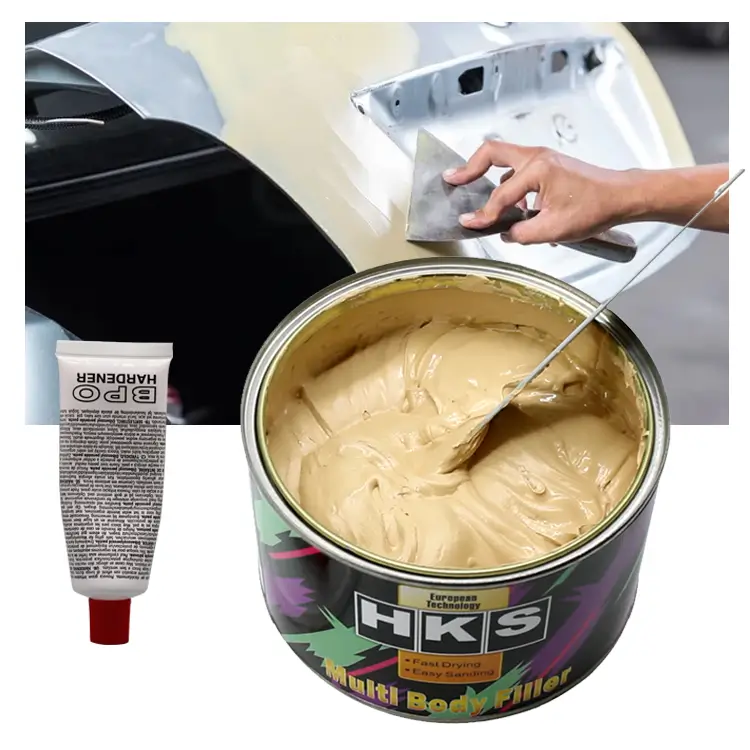
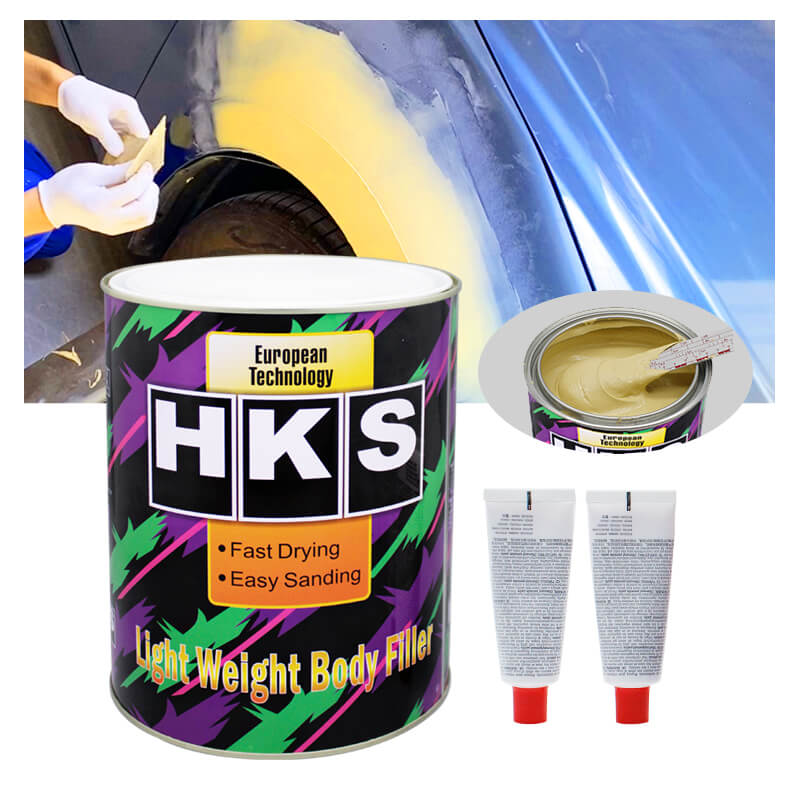
Putties are a type of paint that are made up of 2 components (putty and hardener) which are used to fill, even and level a surface that will subsequently be painted. The process of applying the putty is called filling process.
Choosing the right putty and investing the time required for a correct application will allow optimising of the sanding process, which is one of the most time-consuming steps in bodyshop repairs. It will also help increase the quality of subsequent processes, such as priming or finishing paints.
Let us now look at the steps that will allow optimising the putty application process, while increasing the profitability of the repair.
In general, workshops usually perform the mixing using a “rough estimate”. A lack of the right experience may lead to the problems described above. As a recommendation, to make sure you are getting the ideal mixing ratio by using the precision scale.
How to apply the polyester putty
In this step the concept “pot life” of the mixture, that is, the time you have between the moment you mix the putty with the hardener until the mixture hardens, becomes especially relevant. This time may also be influenced by both ambient and substrate temperature.
When applying the putty, it must be spread evenly, making even coats from one end to the other and exerting appropriate pressure on the spatula. This will enable removing air occluded during application, in order to obtain a smooth and regular surface.
To better control the application of the putty and the speed at which it hardens, we recommend applying it in small amounts whenever possible. In curved areas, you can use rubber spatulas, as they are more flexible.
One of the most important aspects to consider is the amount of putty to be applied:
Excessive product:you run the risk of having surface stiffness problems, making the sanding process more expensive, and therefore less profitable in terms of time and material used.
Insufficient amount of putty: similarly, an insufficient amount of putty can also lead to adherence problems and to poor leveling of the surface to be sanded.
Always comply with the putty’s drying times
The putty’s drying time is stated in the technical data sheet and will start right at the moment the mixing takes place, leading to the chemical reaction and subsequent hardening.
Depending on ambient temperature, this drying process will be faster at high temperatures, and slower at low temperatures. In addition, the support’s (metal or plastic) temperature can also influence the drying time.
Generally, the drying time of the putty is between 20 and 30 minutes at a temperature close to 20ºC (it can vary depending on the type of putty).
Also, the drying time of the putty will influence its subsequent sanding:
Excessive drying time: will cause it to harden further, making sanding difficult and increasing the time required.
Insufficient drying time: if the putty has not dried completely, it could lead to clogging problems during sanding.
In conclusion, it should be noted that if the surface is not in optimum condition for sanding after application, you can re-apply putty in the more irregular areas.
Source of this article:https://www.supersybon.com/
Get to know us through more channels: